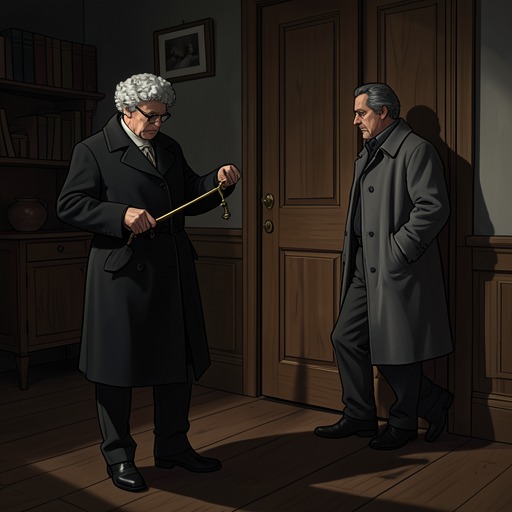
Poirot’s “Everything matters” principle
The Mysterious Affair at StylesPoirot’s “Everything matters” principle is a method of investigation built on attention, comparison, and revision. Rather than deciding in advance which details count, Poirot follows each fact to the next, tests whether it fits, and treats any stubborn mismatch as a missing link worth examining. Its force becomes clear in the Styles case: the principle prevents premature certainty, weakens a conspicuously tidy case against Alfred Inglethorp, and helps Poirot reconstruct how Emily Inglethorp was poisoned.
Method and Meaning
Poirot describes detection as a sequence of connected facts. A new detail either fits what has already been established, allowing the inquiry to proceed, or fails to fit and demands investigation. Even something that appears paltry may prove significant because the discrepancy points to a link that the current explanation has not supplied.
The principle is not simply an injunction to collect information. It is a discipline against dismissing inconvenient evidence: Poirot warns that the detective who decides a fact is too small to matter risks confusion. Hastings has tried to recount all the details, even those whose relevance he cannot see; Poirot praises his faithful memory while noting that his ordering of the facts is poor and that he has omitted one crucial point. Thoroughness supplies the material, but the investigator must still arrange and test it.
Testing Explanations Against Evidence
Poirot applies the method to the claim that Emily died of strychnine poisoning administered in her coffee. He asks when the coffee was served, making the timing of the suspected medium part of the investigation rather than treating the poisoning theory as settled. The question demonstrates the principle in practice: a general conclusion must be checked against the particular circumstances that could make it possible.
The same standard governs Poirot’s assessment of suspicion against Alfred. His excuse for being away from the house seems fabricated, but Poirot reasons that if Alfred knew his wife would be poisoned that night, he would have arranged to be absent. The suspicious absence therefore leaves open two different explanations: foreknowledge of the crime, or an independent reason for being away. Poirot does not let an incriminating appearance decide between them without further evidence.
When Hastings calls a curious fact unimportant, Poirot objects that the theory must give way if the fact will not fit it. This is the principle’s corrective force: evidence is not made irrelevant merely because it disrupts a preferred account. A sound explanation must accommodate the details rather than forcing them into a preconceived pattern.
Manufactured Evidence and the Missing Link
Poirot also uses the principle to detect evidence that is too conclusive. At Leastways Cottage, he argues that genuine evidence is usually vague and unsatisfactory and must be sifted; the case against Alfred, by contrast, has been made so neat that it betrays deliberate manufacture. In Poirot’s view, the criminal’s anxiety to tighten the net has made it possible to cut through the accusation and free Alfred.
This reversal shows why the method demands scrutiny of a clue’s character as well as its apparent meaning. Evidence that seems to point directly to a suspect may be less trustworthy, not more, if its conspicuous completeness suggests staging. Poirot’s rule therefore guards against both overlooking small discrepancies and mistaking an artificially smooth case for a proven one.
The Principle at the Solution
The final reconstruction gives the principle its clearest demonstration. A damp stain in Emily’s bedroom smelled of coffee and contained small fragments of china. Poirot connected those details with a table that tilted and had caused his own case to fall in precisely the same spot. He inferred that Emily’s coffee cup had broken there too. The coffee had not been drunk; she had instead heated and drunk her cocoa, which Poirot says contained no strychnine.
That apparent dead end redirected the inquiry to Emily’s medicine. Poirot identifies the fatal strychnine as the same substance prescribed by Dr. Wilkins and explains that it was already present in the mixture. The overlooked distinction between coffee, cocoa, and medicine changes the account of how the poison was taken: the familiar theory of poisoned coffee cannot explain the evidence, while the medicine does.
The timing supplies another link. The murder was intended for Monday evening, when Emily’s cut bell wire would have left her isolated in the right wing and Cynthia would have been staying with friends. But Emily forgot her medicine while hurrying to a village entertainment, then lunched away from home the next day. The fatal dose was consequently taken twenty-four hours later than the murderer anticipated. Poirot presents a letter in the murderer’s handwriting as the final link, connecting the delayed poisoning to the plan and showing how an apparent accident in timing preserved the proof.
Significance in the Investigation
The principle joins open-mindedness to rigorous testing. Poirot does not treat every observation as equally conclusive; he insists that none be discarded simply because it seems inconvenient or trivial. Details gain meaning through their relations to one another, and a theory remains provisional until it can account for the chain as a whole.
In the Styles case, this approach drives successive reversals: suspicion of Alfred is not accepted at face value, unusually tidy evidence is recognized as manufactured, and the unconsumed coffee leads away from the expected medium toward the medicine. “Everything matters” is thus both a maxim of attention and a rule for reasoning: preserve the awkward fact, follow what it changes, and let the explanation—not the investigator’s first impression—stand or fall by the evidence.